There’s a moment every event organizer knows well — that nervous gap between having a killer lineup and actually selling tickets. The venue is booked, the artists are confirmed, and somewhere on a laptop screen sits a freshly designed poster that needs to convince thousands of people to show up. This is exactly where poster mockup tools have quietly become one of the most powerful weapons in the event promotion arsenal.
Why First Impressions Sell Tickets
Concert and festival promotion is fundamentally a visual game. Before anyone reads the lineup, before they check the date, they see the poster. And in an age of Instagram Stories, Facebook event banners, and digital billboards, a flat design file simply doesn’t cut it anymore.
Mockups solve a very specific psychological problem: people struggle to connect emotionally with raw design files. But the moment you drop that same artwork into a realistic street scene — stuck on a brick wall, tucked under a café window, glowing on a city kiosk at night — suddenly it lives. It breathes. It feels real before the event even exists.
Event organizers have caught on, and they’re using mockups far more strategically than most people realize.
Real-World Ways Organizers Put Mockups to Work
This isn’t theoretical. Across the events industry, mockups are embedded into practical workflows at every stage of the promotional cycle.
Pre-sale sponsor pitching is one of the most overlooked applications. Before a festival even goes public, organizers need sponsors on board. Walking into a brand meeting with photorealistic visuals of the poster displayed at a venue entrance, on merchandise, or across social channels dramatically increases credibility. Sponsors see the vision, not just a pitch deck.
Social media content calendars rely heavily on mockups for variety. Rather than posting the same flat artwork repeatedly in the weeks leading up to a concert, marketing teams use multiple mockup angles — close-ups, wide environmental shots, held-in-hand compositions — to keep feeds visually fresh without redesigning anything.
Press kit materials for music blogs, local newspapers, and influencer outreach packages almost always include mockup-enhanced visuals. Editors and bloggers are far more likely to feature an event when the supplied imagery looks polished and publication-ready.
Merchandise previews represent another clever use case. Festival merch — tote bags, t-shirts, limited edition prints — can be previewed using poster mockups repurposed for product contexts, giving audiences a taste of the experience economy surrounding the event.
Mockups in Practice: Case Studies Worth Noting
Consider an independent jazz festival team in a mid-sized European city. Working with a tight budget and no in-house photographer, they used layered poster mockups to create a complete visual campaign showing their artwork across outdoor pillars, subway corridors, and folded flyers. Their social engagement in the two weeks before the event jumped significantly compared to previous years — purely because the content looked like it belonged in the city.
Or take a touring electronic music act whose manager used mockup scenes to pitch regional promoters in three countries simultaneously. Instead of describing the aesthetic, they sent fully rendered visuals of the poster displayed in context. Booking conversations moved faster.
Even small open-air cinema events have adopted this approach — using evening-lit outdoor mockup environments to match the atmosphere of their screenings, making promotional content feel emotionally consistent with the actual experience.
Poster Mockups on ls.graphics
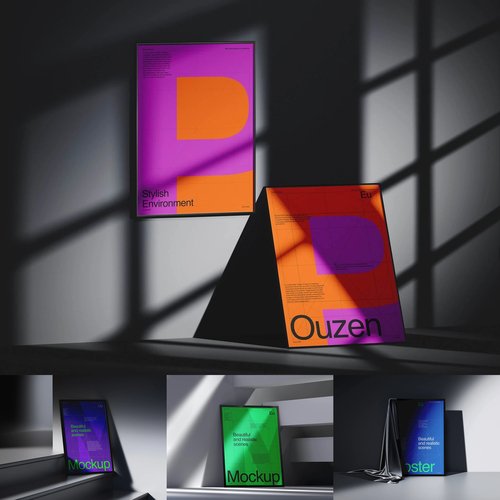
If you’re looking for mockups that genuinely elevate promotional work rather than just filling a content gap, the poster mockup collection at ls.graphics sets a high bar.
What makes it stand out:
- Ultra-realistic rendering that holds up under close inspection — no telltale flatness or artificial lighting
- Organized layered files that make swapping artwork a matter of seconds, not minutes
- Multiple angles and perspectives for each scene, giving campaigns built-in visual variety
- Different color styles to match the mood of any event genre, from neon-drenched raves to muted folk festivals
- Stylish minimalist compositions that let the poster artwork remain the star
- Edit Online feature for quick customization without opening any software
- A generous selection of free scenes to explore before committing
For teams that need to move fast and look professional doing it, this kind of toolkit removes friction at exactly the right moment in the workflow.
Conclusion
Poster mockups have graduated from a designer’s convenience tool to a core component of modern event marketing. They close the gap between concept and conviction — helping organizers pitch sponsors, build social momentum, and make audiences feel an event before it happens. When the visuals look real, the event feels inevitable.
For anyone serious about elevating their promotional game, the collection at ls.graphics is a genuinely strong starting point — built for people who understand that in the attention economy, presentation isn’t vanity. It’s strategy.