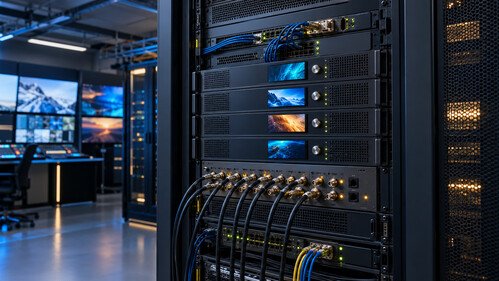
The transition from high-definition to 4K video has changed far more than picture resolution. It has increased the amount of data that must be captured, compressed, transported, modulated, received, and displayed-often without expanding the bandwidth available to the operator. In professional television distribution, hospitality networks, campuses, healthcare facilities, sports venues, and other managed environments, 4K encoders and QAM modulators help solve this problem. Together, they convert high-quality source video into bandwidth-efficient digital television services that can travel through existing coaxial infrastructure. Although the two devices perform different jobs, they are closely connected within a complete signal chain. A 4K encoder compresses incoming ultra-high-definition video into a manageable digital stream. A QAM modulator packages one or more digital programs into a radio-frequency channel suitable for cable distribution. Understanding how these functions interact is essential when planning a reliable 4K delivery system.
What Is a 4K Encoder?
A 4K encoder is a device or software-based system that receives uncompressed or lightly compressed video with a resolution commonly defined as 3840 × 2160 pixels. It then uses a video compression standard to reduce the required data rate while preserving an acceptable level of visual quality. The encoder may accept video through professional baseband interfaces, consumer-oriented multimedia connections, or network-based inputs, depending on the application.
Raw 4K video requires an enormous amount of bandwidth. Resolution alone contains four times as many pixels as 1080p video, while higher frame rates, wider color gamuts, greater color depth, and high dynamic range can increase the data load further. Directly transporting this signal over a conventional cable television network is generally impractical. Compression therefore becomes the key enabling technology.
Modern 4K workflows frequently use High Efficiency Video Coding, also known as H.265 or HEVC. Compared with older compression standards, HEVC can deliver similar perceived image quality at a lower bitrate, although actual performance depends on content, encoder design, latency settings, and processing resources. Advanced Video Coding, or H.264, may still appear in some systems, but achieving efficient 4K delivery with it usually requires considerably more bandwidth.
The output of an encoder is normally an elementary video stream combined with encoded audio and service information. These components are often packaged in a transport stream for delivery to a multiplexer, modulator, network gateway, or other distribution equipment. Depending on the design, one encoder may process a single 4K source or several channels at different resolutions.
The Role of QAM Modulation
Quadrature Amplitude Modulation, abbreviated QAM, is a modulation method widely used to carry digital television signals over coaxial cable networks. It transmits information by changing the amplitude and phase of a radio-frequency carrier. Different QAM orders represent different numbers of data points, or symbols, and therefore offer different balances between capacity and robustness.
In a typical cable television system, the QAM modulator receives a multiplexed transport stream containing one or more programs. It adds the necessary framing and error-correction structure, maps the digital information onto a QAM constellation, and creates an RF output at a selected frequency. That channel can then be combined with other RF channels, amplified, and distributed through the coaxial network to compatible televisions or set-top receivers.
Higher-order modulation provides more data capacity within the same channel bandwidth but requires a cleaner transmission path. A signal with more constellation points is more sensitive to noise, distortion, reflections, and level errors. For this reason, successful 4K distribution depends not only on compression efficiency but also on the condition and design of the RF network.
How Encoding and Modulation Work Together
The encoder and modulator address two separate constraints. Encoding reduces the amount of digital data, while modulation adapts that data for transmission over an RF network. A simplified workflow begins with a 4K source. The encoder compresses its video and audio into a transport stream. If several services are carried, a multiplexer combines them and manages their aggregate bitrate. The QAM modulator then converts the stream into an RF television channel.
At the receiving end, a compatible tuner demodulates the QAM signal, identifies the selected program, and passes the compressed video to a decoder. The decoder reconstructs the images for display. Every stage must support the relevant resolution, codec, transport format, audio format, and service metadata. A chain is only as capable as its least compatible component.
Bitrate management is particularly important. A QAM channel has a finite usable payload, determined by channel width, symbol rate, modulation order, forward error correction, and the applicable regional television standard. The total bitrate of all video, audio, metadata, and system information placed in that channel must remain below this payload. Operators also need a safety margin because poorly controlled variable bitrate peaks can cause buffer errors, packet loss, or visible artifacts.
Critical Video Parameters
Resolution is only one element of a 4K signal. Frame rate has a strong effect on both motion quality and bitrate. Content at 50 or 60 frames per second is valuable for sports, live events, and fast movement but generally requires more data than content at 24, 25, or 30 frames per second. Progressive scanning is standard in most 4K applications.
Color sampling and bit depth also matter. Professional contribution feeds may use richer chroma sampling, while distribution systems often reduce chroma information to improve efficiency. Ten-bit processing can support smoother gradients and is commonly associated with high dynamic range. If the encoder, downstream receiver, or display does not support the chosen combination, viewers may see incorrect colors, banding, a washed-out image, or no picture at all.
Audio should be planned with equal care. The encoder may carry stereo, multichannel, or compressed surround sound, but receivers must recognize the selected audio format. Program identifiers, language descriptors, captions, and other accessibility data should also be maintained throughout encoding, multiplexing, and modulation.
Constant and Variable Bitrate Operation
An encoder can operate with a constant bitrate, a variable bitrate, or a constrained form of variable bitrate. Constant bitrate operation is predictable and simplifies capacity planning, which is useful when the service must fit inside a fixed QAM payload. However, it may allocate more data than necessary to simple scenes and too little to complex scenes.
Variable bitrate encoding adjusts data usage according to picture complexity. A static interview may require relatively few bits, while detailed motion or rapid camera movement can require substantially more. Variable bitrate can improve average efficiency, but peaks must be controlled. Statistical multiplexing can allocate capacity dynamically among several services, although it adds complexity.
Latency is another major tradeoff. More sophisticated compression may examine additional frames before making encoding decisions, which improves efficiency but increases delay. For one-way television viewing, moderate latency may be acceptable. For live production, gaming, auctions, confidence monitoring, or interactive events, end-to-end delay can be critical. The correct design balances bitrate, image quality, processing time, and operational requirements.
Network and RF Design Considerations
An efficient encoder cannot compensate for a badly designed coaxial plant. The RF network must provide adequate signal level, carrier-to-noise ratio, modulation error ratio, and impedance matching at every outlet. Excessive amplification can be as harmful as insufficient signal strength because overloaded components introduce distortion. Poor connectors, damaged cable, unterminated ports, and incorrect splitter selection can create reflections or ingress noise.
Transport stream integrity also deserves monitoring. Useful indicators include continuity counter errors, program clock reference accuracy, buffer compliance, missing tables, and bitrate overflow. On the RF side, pre-error and post-error correction measurements, constellation quality, and modulation error ratio reveal problems that a simple signal-level reading may miss.
Common Applications
Hotels, resorts, stadiums, universities, healthcare facilities, and corporate sites can use 4K encoding and QAM modulation to distribute television, internal productions, live events, education, signage, or announcements. QAM offers a practical broadcast model: every connected receiver can tune the same RF channel without requiring a separate unicast stream from the headend.
Not every application needs full 4K at every screen. A flexible system may create a 4K service for large premium displays while producing lower-resolution versions for smaller or older receivers. This approach can improve compatibility and conserve capacity, especially when the audience includes a mixture of television generations.
Planning a Deployment
A successful project begins with requirements. Planners should document source formats, service count, expected quality, acceptable latency, audio and captioning needs, receiver capabilities, and available RF spectrum. They should then create a complete bitrate budget that includes video, audio, tables, metadata, and operating margin.
Interoperability testing is essential. Specifications on paper do not always reveal differences in codec profiles, levels, metadata handling, service naming, channel mapping, or tuner behavior. Testing representative receivers with real content can uncover problems before a large deployment. Sports, animation, dark scenes, fine textures, gradients, and rapid edits are useful stress material for evaluating compression quality.
Looking Ahead
4K encoders continue to become more efficient, while distribution systems increasingly combine RF and IP technologies. A facility may receive content over IP, encode it centrally, distribute some services through QAM, and deliver others through multicast or adaptive streaming. This hybrid model allows operators to preserve existing coaxial investments while introducing newer endpoints and workflows.
Ultimately, a strong 4K system is not defined by resolution alone. It depends on coordinated decisions across compression, transport streams, multiplexing, RF modulation, network quality, and endpoint compatibility. When these elements are planned as one system, 4K encoders and QAM modulators can deliver detailed ultra-high-definition video efficiently and consistently across a wide range of professional environments.


